Swipe Right on Learning: How McCallsburg's Teens and Seniors Are Teaching Each Other Something Better
A Tuesday Afternoon at the Library
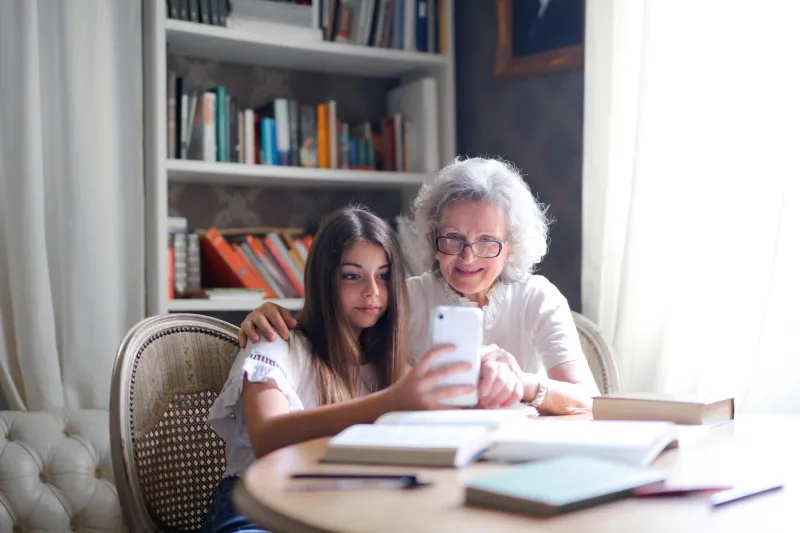
If you walk into the McCallsburg public library on a Tuesday afternoon these days, you might notice something a little unusual. Seated side by side at a table near the window, a teenager and a woman in her seventies are hunched over a smartphone screen. The teen is pointing at something. The older woman is laughing. Neither of them looks like they want to be anywhere else.
This is what a technology gap looks like when a community decides to close it from the inside — not with a government program or a corporate initiative, but with neighbors helping neighbors, across a generational divide that turns out to be a lot more bridgeable than anyone expected.
The Problem Nobody Wanted to Say Out Loud
Here's the honest truth: a lot of older residents in McCallsburg have smartphones they don't fully understand, social media accounts they set up and then abandoned, and a nagging worry that they're being left behind by a world that moved faster than they were ready for.
And a lot of younger residents have the opposite problem — they're fluent in every app and platform imaginable, but sometimes struggle to connect meaningfully with people outside their own age group. They scroll past a lot. They look up less often.
Both of these things are true at the same time, and someone in McCallsburg had the good sense to notice that the solution to one problem was sitting right next to the solution to the other.
What started as an informal arrangement — a high school student helping a grandparent figure out how to video call — has grown into something more intentional. Local organizers, working through the library and a handful of community volunteers, have helped structure regular tech help sessions where younger residents serve as guides for older ones navigating the digital world.
What the Kids Are Teaching
The curriculum, such as it is, starts with the basics. How to set up a secure password that you'll actually remember. How to spot a phishing email before you click something you'll regret. How to use FaceTime to see your grandkids' faces instead of just hearing their voices on a landline.
But it goes further than that. Seniors are learning how to use apps that genuinely improve their daily lives — prescription management tools, weather apps tailored to farming schedules, online banking that saves a trip to the next town over. A few have even gotten comfortable with Facebook and are using it to reconnect with people they'd lost touch with over decades.
"I helped one woman find a friend she hadn't spoken to since 1987," says one student volunteer, a junior at South Hamilton who's been participating in the sessions for almost a year. "She cried. I didn't expect to feel that way about it, but honestly, it kind of got to me too."
Digital safety is a big focus. Scams targeting older Americans have exploded in recent years, and small-town residents can be particularly vulnerable — not because they're less intelligent, but because they're more trusting. Teaching seniors to recognize red flags, verify sources, and protect their personal information is genuinely protective work.
What the Elders Are Teaching Back
Here's the part that tends to surprise people: the learning flows in both directions, and the teenagers seem to be getting as much out of these sessions as anyone.
It's not structured. Nobody planned it. But when you sit across from someone who's lived 70 or 80 years in this community, you end up hearing things that no algorithm could surface for you.
Stories about what McCallsburg looked like before the highway changed, before certain businesses closed, before the school consolidation happened. Practical wisdom about handling conflict without burning a bridge. Perspectives on patience, on setback, on what actually matters when you zoom out far enough.
"There's this guy, Harold — he's 81 — and he always ends up telling me something I think about for weeks," says another student volunteer. "Last time I was there, he told me that the most important skill he ever learned was how to disagree with someone without making them feel stupid. I'm still chewing on that."
Several of the student participants have noted that these conversations have shifted how they think about aging and community. In a culture that often treats older people as irrelevant, sitting down with someone who's genuinely wise — and who's grateful for your help — reframes the whole picture.
The Friendships Nobody Expected
What nobody predicted when this started was that some of these pairings would turn into actual friendships. Not mentorships with a formal structure, not obligatory intergenerational programming, but real, recurring connections between people who like each other and look forward to seeing each other.
One senior participant has started attending the high school's spring play every year — because a student she met at the tech sessions has a lead role and personally invited her. Another has become a regular at a young entrepreneur's family farm stand, not because she needs the vegetables but because she enjoys the conversation.
These are small things. But in a community the size of McCallsburg, small things compound. They become the connective tissue of a town that actually functions like one.
Growing Something Worth Keeping
The sessions are still relatively informal, and organizers are careful not to over-program something that's working precisely because it feels natural. But there's quiet talk about expanding — more consistent scheduling, perhaps a small grant to cover printed materials, maybe a partnership with the local school district to give student volunteers a recognized service-learning credit.
What nobody wants to do is turn it into something that loses the warmth that makes it work. The magic isn't in the curriculum. It's in the Tuesday afternoon when a teenager and a 74-year-old woman are laughing together over a smartphone screen, each one a little less alone than they were an hour ago.
McCallsburg has always known how to take care of its own. This is just the newest version of that old, good instinct.